How to Experience Cambridge From Every Angle: A First-Time Visitor’s Guide to Understanding the University City
Cambridge can look surprisingly small when you first open a map. King’s College, Trinity College, Market Square, the River Cam and many of the city’s best-known landmarks are concentrated within a compact historic centre. It is therefore easy for first-time visitors to assume that Cambridge can be understood simply by walking between a handful of famous sights.
The reality is much more interesting.
Cambridge is not a university campus surrounded by a city. The University, its colleges and the city have developed alongside one another for more than 800 years. Historic colleges sit beside shops and churches, students cycle between centuries-old buildings and modern academic departments, while museums, residential neighbourhoods and green spaces form another layer of Cambridge beyond the famous postcard views.
For a first visit, the best approach is not necessarily to see the greatest possible number of landmarks. It is to experience Cambridge from several different perspectives. A panoramic introduction can reveal the shape of the city; walking explains its historic streets and colleges; a student-led experience opens the door to contemporary university life; the River Cam reveals the College Backs; and the Fitzwilliam Museum introduces another side of Cambridge through art, archaeology and collecting.
Together, these perspectives explain why Cambridge is much more than a collection of beautiful university buildings.
1. Start With the Bigger Picture: Cambridge University Is Everywhere
One of the most common questions first-time visitors ask is: “Where is the University of Cambridge?”
There is no single answer because there is no conventional central campus.
The University began developing in the early thirteenth century, while its colleges were established at different points over many centuries. Individual colleges developed their own accommodation, dining halls, chapels, libraries, gardens and traditions, while University faculties and departments were established elsewhere around the city.
As a result, Cambridge grew into a university city rather than a city containing one clearly defined university campus.
This is why seeing Cambridge from a wider perspective can be useful at the beginning of a visit. From the upper deck of an open-top sightseeing bus, for example, visitors can observe how the compact historic quarter connects with other parts of Cambridge. The bus is not a We Are Cambridge product, but it can provide a useful introduction for visitors who want to establish their bearings before exploring in greater depth.
From above, architectural periods become easier to compare and the transition between historic and more modern Cambridge becomes clearer. Once you return to street level, the individual landmarks begin to fit into a much larger picture.
2. Walk Cambridge to Understand What the Buildings Actually Mean
A panoramic view can explain where things are, but Cambridge reveals its most important details on foot.
At street level, visitors begin to notice how closely university life and the wider city overlap. College gateways appear between shops and churches. Narrow historic lanes connect major university streets. Buildings constructed centuries apart stand almost side by side.
This is where both our 90-Minute Shared Cambridge Walking Tour and 90-Minute Private Cambridge Walking Tour become particularly useful.
The shared experience is ideal for visitors looking for a structured introduction to Cambridge’s history and principal university quarter. Rather than simply moving between famous photo locations, the tour helps explain how the collegiate system developed, why Cambridge has no single university entrance and how individual colleges relate to the wider University.
The private version provides greater flexibility for families and groups who want the conversation to reflect their interests. Some visitors are particularly interested in architecture; others want to understand British university traditions, important historical figures or how Cambridge developed from a medieval town into an internationally recognised centre of education and research.
The important distinction is between seeing a building and understanding its context. A map can tell you its name. A deeper walking experience can explain why it is there and how it fits into the Cambridge story.
3. Meet the Living University Through a Student Perspective
Historic architecture explains where Cambridge came from, but it does not automatically explain what studying here is like today.
Visitors frequently have questions that cannot be answered simply by looking at college façades. What is the relationship between a college and the wider University? What are supervisions? How does a student’s week actually work? What role do libraries, societies and Formal Hall play in college life? And what does it feel like to study in spaces with centuries of academic history?
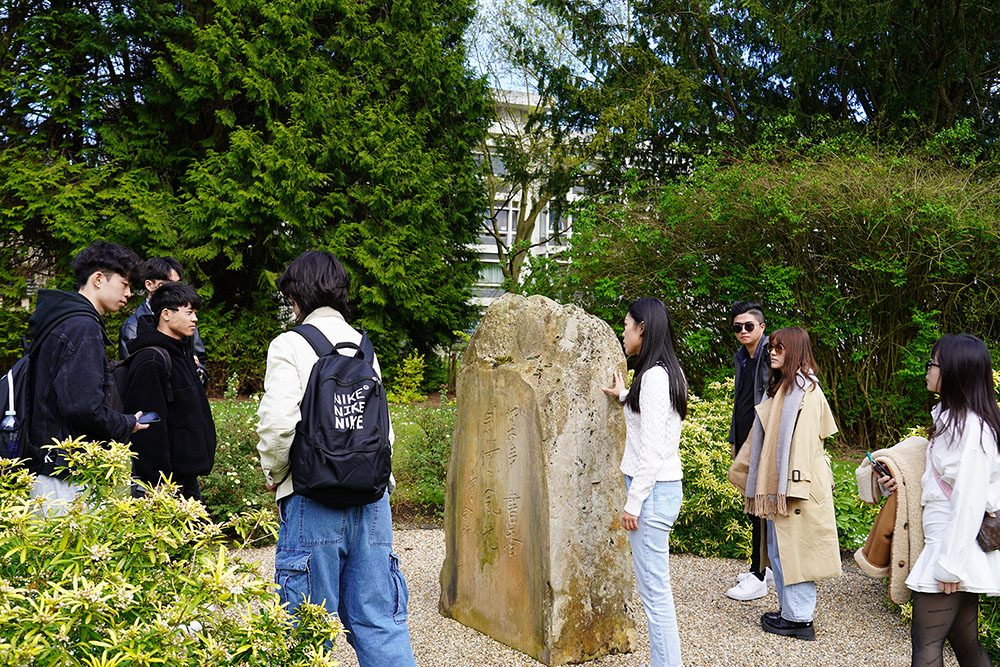
For visitors interested in this living side of Cambridge, the 2.5-Hour Shared Student-Led Cambridge Tour provides a deeper perspective. The longer format creates space to explore both university history and contemporary student experience rather than treating Cambridge purely as a heritage destination.
The 2.5-Hour Private Student-Led Cambridge Tour is particularly suitable for families, prospective students and private groups who want a more conversational experience. It allows more opportunity for questions about academic culture, college life, university traditions and the realities of studying in Cambridge.
This student perspective matters because Cambridge is not an open-air museum. The historic buildings visitors photograph remain part of active academic communities. Students still live, study, dine and socialise within spaces that have evolved over generations.
Understanding that living continuity changes the meaning of the architecture around you.
4. See the Other Side of Cambridge From the River Cam
After exploring Cambridge from the streets, the River Cam reveals a remarkably different city.
From public roads, many colleges appear relatively enclosed. Visitors see gateways, walls and formal façades, but it can be difficult to appreciate how far some college grounds extend behind them. Along the River Cam, that hidden geography begins to appear.
The famous College Backs bring together historic buildings, gardens, lawns, trees and bridges into one continuous university landscape. Colleges that seemed disconnected while walking through the city suddenly become easier to place in relation to one another.
Our Shared Cambridge Punting Tour allows visitors to experience this landscape while professional commentary provides context for the colleges, bridges and university history encountered along the journey. Punting is certainly one of Cambridge’s most photogenic traditions, but its value goes beyond the classic photograph: the river provides one of the clearest ways to understand the physical relationship between several historic colleges.
For couples, families and groups who prefer a more personal setting, the Private Cambridge Punting Tour offers the opportunity to experience the River Cam together in a private punt.
Walking and punting therefore should not necessarily be viewed as competing activities. They answer different questions. Walking explains Cambridge from the street; punting reveals what lies behind many of those historic façades.
5. Cambridge Is Also a City of Art, Museums and Intellectual Collections
It is easy for first-time visitors to concentrate so heavily on the colleges that they overlook another important part of Cambridge: its museums and collections.
The Fitzwilliam Museum provides one of the strongest examples. Its collections span art and material culture from different periods and regions, offering visitors an opportunity to explore Cambridge through a perspective that is very different from college architecture or university traditions.
Our Shared Fitzwilliam Museum Tour is designed for visitors who want more than an independent walk through the galleries. A guided experience can provide structure to a large collection, drawing connections between selected objects, artistic movements, historical periods and the wider intellectual culture associated with Cambridge.
For visitors with particular interests, families or smaller groups, the Private Fitzwilliam Museum Tour allows the experience to become more focused and conversational.
Including a museum in a Cambridge itinerary can also improve the rhythm of a day. Instead of moving continuously from one college landmark to another, visitors encounter a different type of history—one expressed through paintings, sculpture, archaeology and objects rather than streets and university buildings.
It is a reminder that Cambridge’s intellectual identity extends far beyond its most photographed colleges.
6. Build Your Cambridge Day Around Perspectives, Not a Checklist
The most common mistake in Cambridge itinerary planning is trying to fit everything into a checklist.
King’s College: done. Trinity College: done. Mathematical Bridge: done. Bridge of Sighs: done. Punting: done.
A visitor can technically complete a long list and still leave without understanding how any of those places relate to one another.
A stronger itinerary is built around perspectives.
A first-time visitor might begin by gaining a broader view of Cambridge before joining a 90-Minute Shared Cambridge Walking Tour to understand the historic university quarter. The River Cam can then reveal the College Backs through a Shared Cambridge Punting Tour , while visitors interested in the reality of university life can dedicate more time to a2.5-Hour Shared Student-Led Cambridge Tour.
Another visitor may have completely different priorities. A family could prefer a 90-Minute Private Cambridge Walking Tour , followed by a Private Cambridge Punting Tour , giving them greater flexibility throughout the day. Visitors particularly interested in culture might combine the historic centre with a Private Cambridge Punting Tour or choose the private museum experience for greater depth.
That flexibility is important because there is no single “correct” way to experience Cambridge.
Some visitors come for history. Some are fascinated by architecture. Others want to understand Cambridge University as an educational institution. Families may want their children to speak with current students, while returning visitors may prefer museums, hidden streets or a slower exploration of the River Cam.
At We Are Cambridge, our role is not simply to move visitors from landmark to landmark. It is to help them choose the perspectives that make Cambridge meaningful to them.
A sightseeing bus can show you the scale of the city. A walking tour can explain its historic streets. A student-led experience can reveal the University as it exists today. Punting opens the landscape behind the colleges, while the Fitzwilliam Museum introduces centuries of art and collecting.
When these different perspectives come together, Cambridge stops feeling like a collection of famous names on a map.
It becomes what it really is: a living university city shaped by more than eight centuries of education, architecture, culture, landscape and everyday life.
The best Cambridge visit is not about how many places you can tick off in one day. It is about leaving with a clearer understanding of how the city fits together—and why it has remained so distinctive for centuries.
Written by We Are Cambridge.



![[slide:title]](/static/upload/image/20260830/1788098707824958.webp "[slide:title]")



 Book Shared Punting